
Judicial System of Pakistan: Time for Truth and Accountability
November 24, 2025
Arbitration in Pakistan: Past, Present & Emerging ADR Trends
November 26, 2025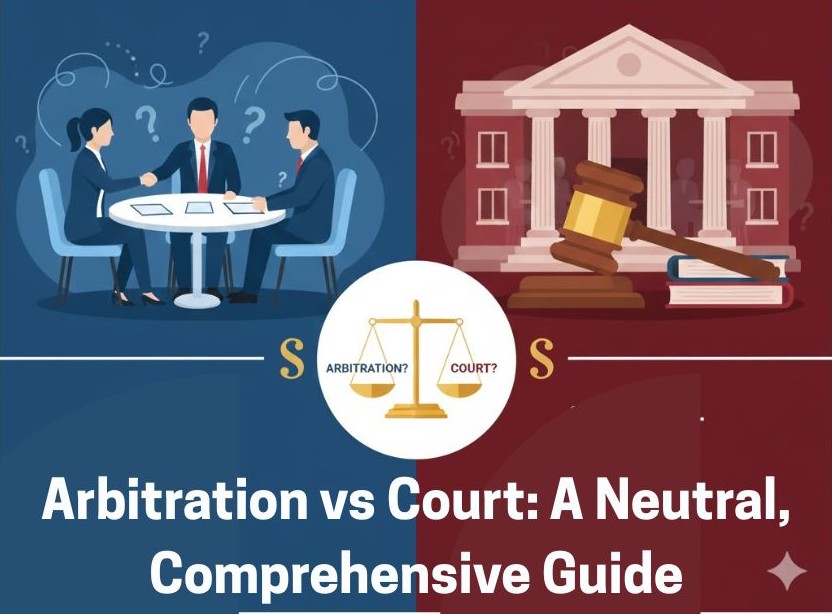
When a conflict escalates beyond negotiation, the first thought is usually to go to court. In Pakistan—and globally—this is the default response. However, when comparing Arbitration vs Court, arbitration has quietly emerged over the last decade as a strong alternative. Businesses, contractors, partners, and even individuals are increasingly exploring private dispute-resolution pathways instead of committing immediately to litigation. In Pakistan, arbitration is governed by the Arbitration Act, 1940, which sets out the legal framework for private dispute resolution outside the courts.
In the debate of Arbitration vs Court, which method works better in real-world scenarios?
This article explores the answer from a completely neutral perspective, so you can understand the strengths and weaknesses of both options before choosing the path that fits your situation.
Understanding Arbitration vs Court: How Each Dispute-Resolution Method Works
What Is Arbitration?
Arbitration is a private dispute-resolution mechanism where the parties appoint an arbitrator—usually an experienced professional in law, business, finance, engineering, or another relevant field—to hear both sides and issue a final, binding decision.
It mirrors the structure of a courtroom hearing but removes many of the layers that slow litigation down, such as excessive procedural requirements, rigid scheduling, and long waits for hearing dates.
Arbitration is commonly used in:
- Commercial contracts
- Property and tenancy matters
- Partnership and shareholder disputes
- Construction disagreements
- Cross-border business conflicts
In many contracts today, an arbitration clause is included so that if a dispute arises, both parties must settle it through arbitration before considering litigation.
Comparing Arbitration vs Court: Pros and Cons
Instead of claiming one is “better” than the other, it’s important to understand that both systems serve different needs. The key is identifying which one aligns with your goals, budget, urgency, and the nature of the dispute.
Advantages of Arbitration
- Faster resolution: Arbitrations typically conclude within months instead of years because the parties control scheduling.
- Privacy: Proceedings are confidential, which is valuable for business disputes or matters involving reputational risk. Many commercial disputes in Pakistan are now handled through institutional arbitration, such as CIICA (Center for International Investment & Commercial Arbitration), which offers both domestic and international arbitration under its modern framework.
- Flexibility: Parties can choose the arbitrator, venue, procedures, and governing rules.
- Specialized decision-makers: An arbitrator with industry expertise can understand technical matters better than a generalist judge.
- Less procedural complexity: Fewer formalities mean fewer delays caused by adjournments, filings, and procedural objections.
- Finality: Arbitration decisions (awards) are binding and usually cannot be appealed, providing closure faster.
Disadvantages of Arbitration
- Limited appeal rights: Overturning an arbitrator’s award is extremely difficult.
- Costs vary: Arbitrator fees can be high depending on experience and dispute complexity.
- No strict evidence rules: Some parties prefer the structured rules of evidence used in courts.
- Not suitable for all disputes: Criminal matters, family law issues, and cases involving public interest must go to court.
- Enforcement challenges: While arbitral awards are enforceable, enforcing them still requires court involvement.
Strengths and Limitations of Court Litigation
Advantages of Court Proceedings:
- Judicial authority: Court decisions carry the full weight of the state and can set legal precedents.
- Right to appeal: Appellate courts provide a structured remedy if a mistake occurs.
- Comprehensive rules: Strict procedures and evidence rules make outcomes predictable.
- Public accountability: Open hearings ensure transparency when disputes affect society or markets.
Limitations of Court Proceedings:
- Time-consuming: Backlogs in Pakistan often mean cases drag on for years.
- Lack of privacy: Court hearings and records are generally public.
- High procedural complexity: Multiple hearings, adjournments, and technical objections slow progress.
- Limited control: Judges are assigned, schedules cannot be negotiated, and proceedings follow rigid structures.
Real-World Scenarios: Arbitration vs Court in Practice
When to Choose Arbitration vs Court
You may prefer arbitration if:
- You want a quicker resolution
- Your matter is commercially sensitive or private
- You want more control over the process
- You want someone with specialized industry knowledge to decide the case
You may prefer court litigation if:
- Your dispute involves public rights or criminal wrongdoing
- You want the ability to appeal
- You need strong enforcement without additional steps
- You require formal rules of evidence to protect your interests
Arbitration vs Court in Pakistan’s Legal Landscape
In Pakistan, arbitration is steadily becoming the preferred method for commercial and corporate disputes, especially in construction, procurement, technology, real estate, and partnership sectors. Courts themselves have begun encouraging settlement pathways outside litigation to reduce backlog and simplify dispute resolution.
Conclusion: Which Method Fits Your Case – Arbitration or Court?
Both arbitration and court litigation serve important roles in the justice system. The real value lies in understanding which method aligns with your needs. For private, commercial, and time-sensitive disputes, arbitration often provides speed, privacy, and flexibility. For matters requiring judicial authority, public accountability, or detailed legal scrutiny, court litigation remains essential.
If you require guidance or professional assistance with arbitration, dispute resolution, or commercial conflicts, you may contact us at SQLA. Our team provides structured, reliable arbitration support for businesses and individuals seeking a more efficient alternative to litigation.
FAQ
Which is faster: arbitration or court litigation?
Arbitration is generally faster, often resolving disputes within months, while court cases can take years due to backlog and procedural complexity.
Can arbitration decisions be appealed like court judgments?
No. Arbitration awards are usually final with very limited grounds for appeal, unlike court judgments which have structured appellate options.
Is arbitration suitable for all types of legal disputes?
No. Arbitration is best for commercial, contractual, or private matters. Criminal, family law, and public-interest cases must go through courts.
Why choose court litigation over arbitration?
Court litigation is ideal when you need judicial authority, formal rules of evidence, public accountability, or a strong right to appeal.