Property Dispute Lawyer in Lahore – A Complete Guide
January 15, 2026
Landlord Tenant Lawyer Lahore: A Practical Guide to Rent & Eviction Cases
February 3, 2026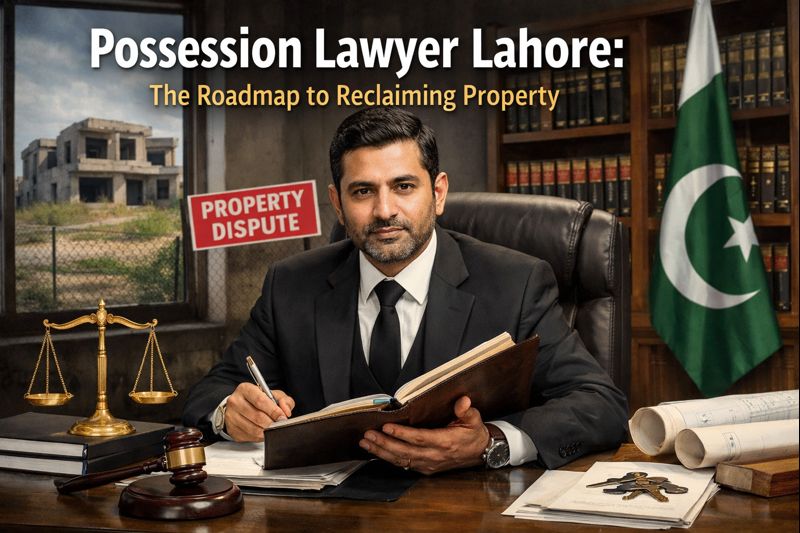
It is a heavy, unsettling realization when a place you worked hard for is held by someone else. That shock often turns into a constant worry as you wonder how to reclaim your property and search for the right possession lawyer in Lahore without getting lost. It is a personal struggle, and feeling overwhelmed by conflicting advice makes sense.
We must recognize the trade-offs here. A quick, informal fix might feel like a relief today, but it lacks the legal finality that prevents the person from returning later. Choosing official channels is a longer road, but it offers a permanent shield for your rights. This journey is about steady steps. As we look at hiring a possession lawyer Lahore or filing a suit for possession Lahore, remember the goal is to ensure your ownership is never questioned again.
1. Finding a possession lawyer Lahore who shares your vision
It is a common worry: will I find a professional who truly cares about my home as much as I do? In a city with thousands of practitioners, finding a possession lawyer Lahore who aligns with your specific needs can feel like searching for a needle in a haystack. Many owners worry that a lawyer might see their struggle as just another case number, missing the personal history and the “why” behind the land. However, it is entirely possible to find a partner who thinks along with you, provided you look for qualities beyond just a fancy office or a high fee.
When you begin this search, consider the trade-off between a large, prestigious firm and a smaller, boutique practice. Large firms often have vast resources, but your case might be handed to a junior associate who doesn’t fully grasp your vision. A smaller practice or a solo possession lawyer Lahore might offer the dedicated, one-on-one attention you crave, though they may have a busier schedule. The “right” choice is often the person who listens more than they talk during your first meeting. If they are already thinking about how to preserve your property’s value while getting you back inside, you have likely found a good match.
You might want to ask a few direct questions to see if their vision matches yours:
- How many cases similar to mine have you handled in the local Lahore Civil Courts this year?
- Do you prefer a path of mediation, or are you ready to fight for a full court decree?
- Who will be my main point of contact when I have a worry at 9 PM on a Sunday?
Finding a lawyer who understands the local landscape is vital. They should know the specific quirks of the revenue offices in areas like Gulberg or Model Town and have a working relationship with the local bailiffs. This grounded, practical knowledge is what actually moves a case forward. It is about building a partnership where you provide the history and they provide the legal strategy.
2. Deciding when to file a suit for possession Lahore
In Lahore, the timing for filing a suit to recover property possession depends on your specific situation and how much time has passed since you lost control of the property.
Here is a breakdown of when to file without focusing on the specific legal sections:
a. If You Were Forcibly Dispossessed (Urgent Case)
If you were physically removed from your property without your consent or a court order, you should act immediately.
- The Deadline: You must file the suit within 6 months of being kicked out.
- Key Point: In this type of case, the court primarily looks at whether you were in possession and were removed illegally. You do not necessarily have to prove full ownership titles at this stage to get possession back.
b. General Recovery Based on Ownership
If the 6-month window has passed, or if you are an owner trying to remove someone who has no right to be there, you file a regular civil suit.
- The Deadline: Generally, you have 12 years from the time the other person’s possession became “adverse” (hostile to your rights).
- Key Point: You must prove your legal title (such as a Registry, Fard, or Allotment Letter) to win this case.
c. Cases Involving Land Mafias (Illegal Dispossession)
If the person occupying your land is a known “land grabber” or part of a “Qabza group,” you can file a complaint in the court of a Sessions Judge.
- Timing: While there isn’t the same strict 6-month cutoff as the summary civil suit, it is best to act as soon as the illegal entry occurs to prevent the occupant from establishing a long-term presence.
Important Practical Steps for Lahore:
- Revenue Records: Visit the Punjab Land Records Authority (PLRA) or the relevant Arazi Record Center to ensure your ownership is correctly reflected in the government records.
- Injunctions (Stay Orders): If you are worried the occupant will sell the property or build on it while the case is pending, your lawyer should ask for a “Stay Order” at the very beginning of the lawsuit.
- The Courts: Most of these cases are handled at the Civil Courts (Aiwan-e-Adal) near the Neela Gumbad/District Courts area in Lahore.
3. The paperwork involved for a property possession case Lahore
Filing for property possession in Lahore requires a mix of historical ownership proof and current government records. Since the Punjab Land Records Authority (PLRA) has moved toward digitalization, the “paper trail” now involves both traditional physical deeds and computerized certificates.
Essential Paperwork Checklist
To file a suit, you generally need to provide your lawyer with the following:
- Proof of Title: The primary document showing you own the property (e.g., Sale Deed/Registry, Allotment Letter from LDA/DHA, or an Inheritance Certificate).
- Fard-e-Malkiat: A recent “Record of Rights” extract from the PLRA (computerized) or the Patwari (manual). This confirms the government currently recognizes you as the owner.
- Aks-Shajra (Map): A trace map from the revenue office showing the exact location and boundaries of the property.
- Possession Proof: Evidence that you were previously in control, such as utility bills (Electricity, Gas, Water) in your name, property tax receipts, or rent agreements if you had tenants.
- Legal Notice: Copies of any formal notices you sent to the occupant before filing the suit.
- Power of Attorney: If you are filing on behalf of someone else (or are an Overseas Pakistani), a notarized and attested Power of Attorney is mandatory.
Ownership Records: Registry vs. Fard
In Lahore’s legal system, these two documents serve different purposes. While both are used in court, they carry different “weights” during a trial.
| Feature | Registry (Sale Deed) | Fard (Record of Rights) |
| What it is | A private contract between buyer and seller, registered with the Sub-Registrar. | An extract from the government’s central land database. |
| Legal Weight | High (Primary Title). It is the actual proof of the transaction and transfer of ownership. | Secondary (Presumptive). It is proof that the government recorded the transaction. |
| Court Stance | A Registry is harder to challenge unless fraud is proven. | A Fard carries a “presumption of truth,” but can be corrected if it contradicts a valid Registry. |
| Common Issue | Sometimes a Registry exists, but the owner forgot to “mutate” (update) it into the Fard. | Sometimes a Fard is updated based on a fake Registry or oral statement. |
Digital vs. Paper Records in Punjab
As of 2026, Lahore operates on a hybrid system. Most “Mauzas” (revenue estates) in Lahore are now computerized through the PLRA, but some older urban areas and specific housing societies still rely on manual registers.
- Digital Records (PLRA): These are considered more transparent. A computerized Fard or E-Registration is issued quickly and is linked to your CNIC. In court, digital records are harder to tamper with because the “history of changes” (log) is tracked.
- Paper Records (Manual): Older properties or those in the “walled city” may still be in the Roznamcha (daily diary) of a Patwari. These manual records are highly susceptible to “over-writing” or “missing pages.”
- The “Gap”: A common legal trap in Lahore is the Mutation (Intiqal). Even if you have a physical paper Registry, if it hasn’t been “entered” into the digital system (PLRA), the government record will still show the previous owner’s name. Courts in Punjab now increasingly demand that the digital record matches the physical deed before granting possession.
4. The steps toward eviction through court Lahore
Evicting a tenant in Lahore is a structured legal journey. It is designed to be faster than a standard civil suit, provided your documentation is in order. Below is the step-by-step breakdown of the process.
Phase 1: The Pre-Court Formalities
Before you ever step into a courtroom, you must satisfy the legal requirements for a “cause of action.”
- Establishing the Ground: You cannot evict a tenant in Lahore “at will” if there is a valid agreement. Common grounds include non-payment of rent, expiry of the lease, personal bona fide need, or violation of the agreement terms (like subletting).
- The Written Notice: You must serve a formal written notice to the tenant. This notice typically provides a period (usually 30 days, though it varies based on your specific contract) to either clear arrears or vacate the premises.
- Proof of Service: Ensure you send this notice via Registered Post with Acknowledgement Due (AD) or a reputable courier. The receipt is a vital piece of evidence for the court to show you gave the tenant a fair chance.
Phase 2: Filing and the Hearing Process
If the tenant refuses to leave after the notice period, the matter moves to the Special Judge (Rent) or the Rent Tribunal.
- Filing the Petition: Your lawyer will file an “Eviction Petition.” Unlike regular civil suits, this must be accompanied by your affidavit and the affidavits of at least two witnesses.
- The Process of Summons: Once filed, the court issues a notice to the tenant. In Lahore, this is often done through multiple channels simultaneously: a process server, registered mail, and sometimes a “proclamation” in a newspaper if the tenant is hiding.
- Leave to Contest: This is a crucial nuance. In Rent Tribunals, a tenant does not have an automatic right to defend the case. They must file an application for “Leave to Contest” within 10–15 days of appearing. If they fail to provide a solid defense, the court can pass an eviction order immediately.
- The Trial: If leave is granted, the court proceeds to a summary trial. Both sides present evidence and cross-examine witnesses. The goal of the Rent Tribunal in Lahore is to conclude these cases within 4 to 6 months.
Comparing Ownership Evidence
When a tenant challenges your right to evict them by questioning your ownership, the court looks at the following:
| Feature | Registry (Sale Deed) | Fard (Record of Rights) |
| Legal Status | A primary title document; proof of the actual purchase transaction. | A presumptive record; shows whose name is currently in the Govt. database. |
| Court Weight | Very High. Difficult to overturn without proving forgery or a newer deed. | High (Presumptive). Accepted as truth unless a Registry proves otherwise. |
| Digital Nuance | Often a physical “stamp paper” document with a seal. | In Lahore, this is now a Computerized Printout from the PLRA (Digital). |
| Requirement | Essential for properties in private societies or old urban areas. | Mandatory for “Mutated” land to prove the state recognizes the owner. |
Phase 3: The Eviction Order and Execution
Winning the case is only half the battle; getting the keys back is the final step. In Lahore, the Rent Tribunal’s decision is not self-executing, meaning the court doesn’t automatically send someone to clear the house the moment the judge signs the paper.
- Final Order: The Rent Controller issues a final order directing the tenant to vacate. By law, the court usually allows a grace period (typically 30 days) for the tenant to leave voluntarily. If the tenant has a strong legal ground, they may use this time to file an appeal in the High Court, which could potentially result in a “Stay Order.”
- The Execution Petition: If the 30-day window passes and the tenant is still occupying the premises, you must file a separate Execution Petition. This is the formal request to the court to implement its own judgment. At this stage, the court will appoint a Bailiff (a court official).
- The Bailiff’s Role: The Bailiff is given a “Warrant of Possession.” They will visit the property and formally ask the tenant to leave. In many cases, the mere arrival of a court official is enough to settle the matter. However, if the tenant locks the doors or threatens resistance, the Bailiff cannot use force on their own.
- Police Assistance: If the Bailiff reports back that they faced resistance or “apprehended a breach of peace,” you must apply for Police Aid. The court then issues a specific order to the local Police Station (Thana). The police will provide a contingent to accompany the Bailiff, break locks if necessary, and physically remove the tenant and their belongings to hand over possession to you.
Comparison of Ownership Records
| Record Type | Registry (Sale Deed) | Fard (Record of Rights) |
| Legal Nature | A private contract registered with the state; proves the transaction. | An extract from the government’s central ledger; proves current status. |
| Evidentiary Weight | Primary. Very difficult to challenge; considered the “root” of ownership. | Presumptive. Assumed correct unless proven otherwise by a Registry. |
| Digital Nuance | Usually a physical document on Stamp Paper with thumbprints and seals. | In Lahore, this is now Computerized (Digital) via the PLRA database. |
| Best Used For | Proving how you became the owner (Sale/Gift/Inheritance). | Proving that the state currently recognizes you as the taxpayer/owner. |
Note on Digitalization: Since the Punjab Land Records Authority (PLRA) went digital, courts in Lahore often demand a Computerized Fard alongside the physical Registry. If your paper Registry says you are the owner but the digital Fard still shows the previous owner’s name, the court may stay the eviction until the “Mutation” (transfer) is fixed in the digital system.
5. Dealing with “Qabza” and the Illegal Dispossession Act
When we speak of “Qabza,” we are moving from a civil dispute into the realm of criminal property theft. This is a serious violation where an individual or a “Qabza group” forcibly takes over your land through intimidation or fraud. Under the Illegal Dispossession Act, the legal system offers a faster track to recovery, but it comes with a significant trade-off: the burden of proof is much higher. Unlike a civil suit, where you argue over who has the better title, here you must prove the criminal intent and the actual act of being forcibly ousted. It is designed to deter land mafias, but because it carries potential prison sentences for the offender, the court requires ironclad evidence of the “force” used. If your case is a “run-of-the-mill” dispute with a relative or a tenant, the court may direct you back to civil proceedings; this path is strictly reserved for clear-cut cases of illegal grabbing.
6. The hidden costs and mental load of litigation
Let’s be honest: the “adjournment culture” in Lahore can be exhausting. You may find yourself dressed for court, having navigated Mall Road traffic, only to be told the case is pushed to next month because a lawyer is on strike or a record is missing. This mental load—the waiting, the uncertainty, and the financial strain—is real. It is vital to stay grounded and realize that while the wheels of justice turn slowly, they do turn. To manage the high stress of a long-term property dispute, don’t hesitate to seek support.
Property disputes often require immediate legal action, and our property dispute lawyers in Lahore can help you resolve such matters efficiently.
7. Preparing your evidence for the long haul
To win, you need to be your own best archivist. Your lawyer can only argue with the ammunition you provide. Use the following checklist to ensure your “evidence file” is ready for trial:
- Visual Documentation: High-resolution photos and videos of the property, showing current occupants or any recent structural changes (broken locks, new walls).
- Witness List: Names and contact details of at least two reliable neighbors or local witnesses who can testify to your possession.
- Utility Records: Original bills for electricity, gas, and water. These are gold in court as they prove who was actually “using” the property.
- Police Reports: Copies of any FIRs or “Rapat” entries you made at the local police station (Thana) immediately after the dispute began.
- Official Correspondence: Any legal notices sent via registered post, including the “Acknowledgement Due” (AD) receipts.
8. Execution of the decree: Getting your keys back
There is a profound sense of hope when a judge finally rules in your favor, but the journey ends only when you physically step back onto your land. Once the decree is issued, you file for “Execution.” This is where the court-appointed Bailiff takes the lead. The Bailiff acts as the court’s physical hand, visiting the site to demand the keys. If the illegal occupant refuses to budge, the court will authorize “Police Aid.” At this stage, local law enforcement arrives to ensure the court’s order is respected, removing the trespassers and their belongings.
Lahore is a city built on history, and your property is a piece of that legacy. Navigating the legal system here requires patience, a thick skin, and the right partner by your side. Whether you are dealing with a wayward tenant or a complex land-grabbing case, remember that the law is ultimately there to protect the rightful owner. Don’t let the fear of a long process stop you from reclaiming what is yours.
Need direct assistance with your property case in Lahore? Our experienced property lawyers in Lahore can assist you in filing and handling property possession cases effectively.